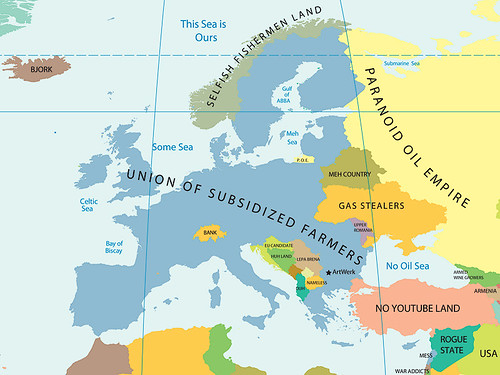
Oh look an example of how surveys of an immeasurable element can generate a whole scheme.

57°08’36.02” N 2°04’16.79” W
Footdee festival (Fittie fest) summer 2008, A time when the Footdee community get together for a good old shindig. There's a bit of a Wickerman vibe and a feeling of paganism at these events. Bangin!
57°09’08.13” N 2°04’49.68” W
This used to be the location of an outdoor skate park. It was run by American Christians. I used to skate and enjoyed the facilities until it rained. When it rained we were forced to listen to stories about Jesus because the ramps were too wet for skating.
57°09’05.01” N 2°04’38.84” W
A year ago in the summer of 2009 (Monday afternoon) one of the hottest days in Scotland. The beach was crammed full. Kids were swimming, surfing, people sun bathing. This was a very rare image for a beach that most of the time is empty...
57°08’43.18” N 2°04’23.92” W
I walked past a bald man pumping a prostitue on a bench that was facing out to sea. It was about 2am, the couple didn't stop or even hesitate. I was quite surprised.
Every time I walk by that bench I remember that couple.
57°08’34.56” N 2°04’10.31” W
This little park near Fittie used to have a very good sand pit and a makeshift pirate ship. I used to go here on a Sunday, play on the park then walk the length of the beach playing frisbee or football. Good times.
57°08’31.99” N 2°04’14.72” W
The area @ Footdee, Silver Darling used to have no railings or protection from driving, walking or diving into the mouth of the harbour/ river Dee. It was only about 10 or 50 years ago they placed up the railings to protect the quay side.
57°08’44.23” N 2°04’45.40” W
A small group of architecture student camped on this corner for 24 hours braving the elements and the sometimes less than friendly neighbours. They pressed the trigger of a camera once every minute for a period of 24 hours. 18-10-2010.
57°08’47.06” N 2°05’30.96” W
This cobbled alley way is a favoured haunt for prostitutes and their clients. I saw the highest density of debauched activity ever in a doorway here, the litter remained from all imaginable human vices.
57°08’44.00” N 2°05’48.52” W
There is a coffee shop/ restaurant around here (I think) called MUSA. It's a lovely place I used to go here quite a lot and I have lots of nice memories not quite sure why I haven't been back, maybe to preserve the good memories?

Last year I came across a blog and the way he justify architecture profession compared to other professions struck my mind.
Whenever you see the word “Client” in something to do with building, you know there just has to be an architect involved because no one else in the building game ever refers to anyone as “clients.” It is such a strange word, isn’t it? In a shop you are a customer, on a train you are a passenger, in a hospital you are a patient, in a class you are a student, in the economy at large you’d be a consumer. But client? The only people who have clients are lawyers, architects and prostitutes, all of whom have to live with the reputation that they are simply out to screw you. Only the prostitute is honest about it.”

Re(collection)
Collection of text from Public intimacy by Giuliana Bruno

Canadian Pavilion - Shanghai Expo courtesy from student
Three-dimensional space, inhabited and set in virtual motion by the body, has formed the material of modern architecture; its representation in two dimensions, with the added dimensions of time, has been the work of film, filmmakers from architects. Sigfried Giedion coined the triplet “space, time, and architecture” ; Le Corbusier and Sergei Eisenstein sewrved the emblematic duo in this cross-medium relationship; Walter Benjamin sealed the marriage as a product of modern technological reproduction; and psychology reinforced it with the concept.
A garment, discarded. A texture holding a text. As part of an aesthetic collection that speaks of its wearer’s taste, the discarded garment enacts recollection, recalling for us the person who inhabited its surface - the lively body that animated it.
The architectural paths of the art of memory
Eisenstein’s imaginistic vision of the filmic-architectural promenade follows a mnemonic path. It bears the mark of the art of memory and, in particular, its was of linking collection and recollection in a spatial fashion. Let us recall that the art of memory was itself a matter of mapping space and was traditionally was an architectural affair. In the first century A.D., more than a hundred years after Cicero’s version. Quintilian formulated hisarchitectural understanding of the way memory works, which became a cultural landmark.1 To remember the different parts of a discourse, one would imagine a building and implant the discourse in site as well as in sequence: that is, one would walk around the building and populate each part of the space with an image. Then one would mentally retraverse the building. Moving around and through the space, revisiting in turn all the rooms that had been decorated with imaging. Conceived in this way, memories are motion pictures. As Quintilian has it, memory stems from a narrative, mobile, architectural of site:
Some place is chosen of the largest possible extent and characterized by the utmost variety, such as a spacious house divided into a number of rooms. Everything of note therein is carefully imprinted on the mind...... the first thought is placed, as it were, in the forecourt; the second, let us say, in the living-room; the remainder are placed in due order all round in the impluvium, and entrusted not merely to bedrooms and parlours, but even to the care of status and the like. This done, when the memory of the facts requires to be revived, all these places are visited in turn.... what I have spoken of as being done in a house can equally well done in connexion with public buildings, a long journey, or going through a city or even with pictures. or we may even imagine such places to ourselves. We require therefore places, real or imaginary, and images or simulacra which we must, of course, invent for ourselves.... As Cicero says, “We use places as wax.” 2
As Frances Yates demonstrates ion her study of the subject, the art of memory is a form of inner writing.3 Such a reading, in fact, can be extended all the way from plato’s “wax block” of memory to the wax slab of mnemonic traces, impressed on celluloid, on Freud’s “Mystic Writing Pad.”4 In cicero and in Quintilian, whose arts of memory are particularly relevant here, the type of inner writing that is inscribed in wax is architectural. Places are used as wax. With respect to this rendering of location, the architecture of memory reveals ties to the filmic experience of place and to the imaginative itinerary set up in a museum. Before motion pictures spatialized and mobilized discourse substituting for memory, in the end - the art of memory understood recollection spatially. It made room for image collection and, by means of an architectural promenade, enable this process of image collection to generate recollection. In this way, memory interacts with the haptic experience of place; it is precisely this experience of revisiting sites that the architectural journey of film sets in place and in motion. Places live in memory and revive in the moving image.
1. Marcus Tullius Cicero’s version of the at of memory is outlined in his De oratore, trans. E. W. Sutton and Harris Rachman (London: Loeb Classical Library, 1942). Marcus Fabius Quintilianus’s rendition of the subject is laid out in his Institutio oratoria, vol.4, trans. H. E. Butler (New York: G. P. Putnam’s Sons, 1922).
2. Quintilian, Institutio oratoria, vol.4: 221-223. 3. See Yates, The Art of Memory; and Yates, “Architecture and the Art of Memory,”
Architectural Design 38, no. 12(December 1968): 573-578. 4. See Plato, Theatetus, trans. Harold N. Fowler (London: Loeb Classical Library, 1921),
and Sigmund Freud, “A Note on the Mystic Writing Pad,” in Complete psychological Works, vol, 9 (London: Hogarth Press, 1956).